Lenses
A practical lens primer
Prime vs. zoom, focal length, T-stops, and what each one is actually for
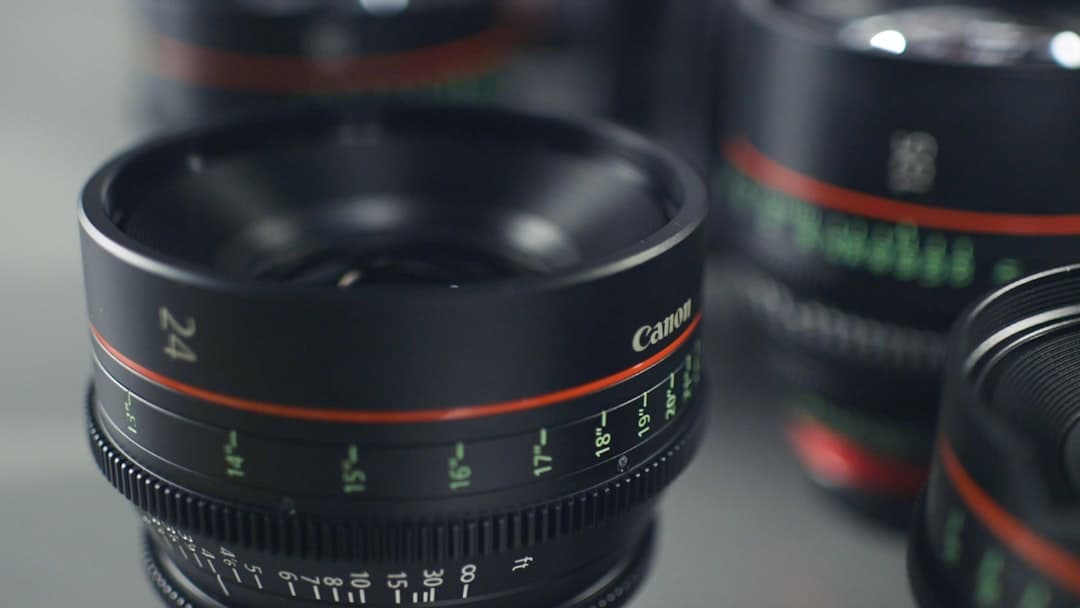
Photo by ShareGrid on Unsplash
What a lens actually does
A lens projects an image of the world onto the camera's sensor. That sounds obvious — but every choice about which lens you put on the camera changes what that image looks like.
Three properties matter most for picking a lens:
- Focal length — how "zoomed in" the lens is, measured in millimeters (mm)
- Maximum aperture — how much light the lens can gather, expressed as an f-stop or T-stop
- Whether it's a prime or a zoom
Everything else (close-focus distance, image stabilization, autofocus quality, lens mount, glass coatings, image circle) builds on those three.
Focal length, intuitively
| Focal length | Common name | What it's for |
|---|---|---|
| 12 – 24mm | Ultra-wide | Landscapes, real-estate, dramatic interiors, anything where you want a sense of vastness |
| 24 – 35mm | Wide | Walking-and-talking, group shots, environmental coverage, documentary |
| 50mm | "Normal" | Closest to how the human eye sees the world. A great all-purpose focal length. |
| 75 – 105mm | Short telephoto / portrait | Interviews, beauty close-ups, dialogue scenes. Flattering on faces. |
| 135 – 200mm | Telephoto | Compression of background, sports, distant subjects |
| 300mm + | Super telephoto | Wildlife, sports, paparazzi, anywhere you can't physically get close |
These are based on a full-frame sensor (a 36×24mm imaging area, the same dimensions as 35mm film). If you're on a smaller sensor, the same physical focal length appears tighter — so a 50mm lens on a Super 35 camera frames more like a 75mm on full-frame. This is called the crop factor, and every sensor has one.
You don't have to memorize crop math. Just know that when you read "use an 85mm for portraits," that advice assumes full-frame; on a smaller sensor you might reach for something shorter.
Wide vs. long: what changes
Longer lenses don't just zoom in — they compress the apparent space between your subject and the background. A subject shot at 200mm with a building behind them will make that building look like it's right behind their head. The same subject shot at 24mm makes the building look distant and small, even from the same physical position.
Wider lenses, in contrast, exaggerate distance between near and far things. A face shot up close at 24mm has comically large features (this is why wide-angle selfies look weird). A face shot at 85mm flatters because it compresses the nose-to-ear distance.
This is the most important thing to internalize: focal length is a storytelling choice, not just a "how close can I get" choice.
Primes vs. zooms
A prime lens has a fixed focal length. A 50mm prime is always 50mm. A zoom lens covers a range — say, 24–70mm.
Zooms are obviously more convenient. So why do most cinematographers prefer primes?
Primes are sharper, faster, and cheaper for what they do. A 50mm prime at T1.4 is achievable for under $1,000. A zoom that opens to T1.4 across its range doesn't really exist; cinema zooms typically open to T2.8 and cost $20,000+. So when you want shallow DOF (see [[understanding-depth-of-field]]) or you're working in low light, primes win.
Primes force composition decisions. You can't lazily zoom in — you have to physically move the camera. That makes for stronger, more intentional shots. Some camera operators carry a small "prime kit" — 24mm, 35mm, 50mm, 85mm — and refuse to zoom on principle.
Zooms still have a place: documentary (where you can't always physically move), wildlife (where you literally can't), and ENG-style multi-camera shoots where one operator covers a whole event. Some hybrid zooms ("cine zooms" or "parfocal zooms") are designed for film/video use, hold focus through the zoom range, and have manual de-clicked aperture rings — they're a real production tool, not a tourist convenience.
Reading the spec sheet
A typical lens spec line might read: 50mm f/1.4 EF. Decoded:
50mm— focal lengthf/1.4— maximum aperture (how wide it opens)EF— lens mount (Canon's mount, in this case)
Cinema lenses are spec'd in T-stops (true transmission) rather than f-stops (theoretical), so the same line for a cine prime might read: 50mm T1.5 PL. PL is the cinema mount standard.
Other things you'll see:
- Image circle. The diameter of the projected image at the sensor plane. A lens designed for full-frame will cover smaller sensors fine; a lens designed for a smaller sensor will produce dark corners ("vignetting") on a larger sensor. Most cinema primes are now full-frame compatible.
- Minimum focus distance (MFD). How close to the camera the subject can be before focus runs out. A long-MFD lens (like 1.5m) can't shoot a close-up of a person's eye from a foot away.
- Filter thread / front diameter. The size of filters that screw onto the front. Sets that use a matte box instead of screw-in filters don't care about this — but solo shooters do, because polarizers and ND filters mount via the front thread.
- Iris blades. The number and shape of the aperture blades affects how out-of-focus points of light render. Round blades = round bokeh; angular blades = polygonal bokeh.
Stills lenses vs. cinema lenses
A stills lens (Canon EF, Sony E, Nikon Z, etc.) is built for photography first. Pros and cons:
Pros: Cheaper. Often sharper for the price. Autofocus. Smaller and lighter.
Cons: Variable focus and aperture rings (no marked distances, no de-clicked aperture). Focus and aperture can shift unexpectedly because they're motor-driven. Lens "breathing" (the image scaling as you pull focus) can be visible.
A cinema lens is built for movie production:
- Manual focus with a smooth, calibrated ring marked in feet and meters
- De-clicked aperture (smooth aperture ramps mid-shot)
- Minimal focus breathing
- Geared rings standard-positioned for follow-focus tools
- Built for repeat takes — focus marks stay accurate
If you're working solo, stills lenses (often called "photo lenses" on set) get you 80% of the way there. If you're working with a focus puller, cinema lenses pay for themselves.
Common mistakes
- Buying focal length kits before knowing your style. Don't drop $5K on a 5-lens prime set before you've shot enough to know if you actually reach for an 85mm or a 24mm more often. Rent. Borrow. Decide based on data.
- Treating zoom as "free coverage." You can't zoom your way into a story you didn't plan. A zoom on the camera does not replace shot planning.
- Ignoring lens character. Two 50mm lenses can produce dramatically different images — different contrast, color rendering, flare, bokeh. The vintage Cooke lens "look" exists for a reason. Test lenses before committing to a project's look.
- Pairing a fast lens with the wrong camera. A T1.4 lens on a noisy camera sensor with poor low-light performance doesn't save you. The lens is one part of the system.
What to practice this week
Borrow or rent three lenses: a wide (24mm or 28mm), a normal (50mm), and a short tele (85mm). Find a person, a wall, and a hallway. Shoot the same conversation framing on each lens — frame the subject the same size by moving the camera, not zooming. Watch how the relationship between subject and background changes.
You'll see what filmmakers mean when they talk about lens "compression" and "intimacy." After this exercise, you'll start picking lenses for the feeling you want — not just to fit the action in frame.
More lessons
Browse all
Audio
Audio fundamentals for video
Why bad audio kills good footage — and how to capture clean sound on a small crew
Audio
Multi-track audio workflow for narrative
Capturing lavs, boom, ambience, and timecode reference cleanly on a multi-input recorder
Business & freelance
Showcasing your work online
A reel that gets calls back, a portfolio site that works, and the basics of being findable
Found this useful?
Bookmark BOLD University and share it with someone learning the craft. New lessons go up regularly.
Back to University