Lighting
The grip department’s toolkit
Flags, nets, silks, and the geometry of shaping light
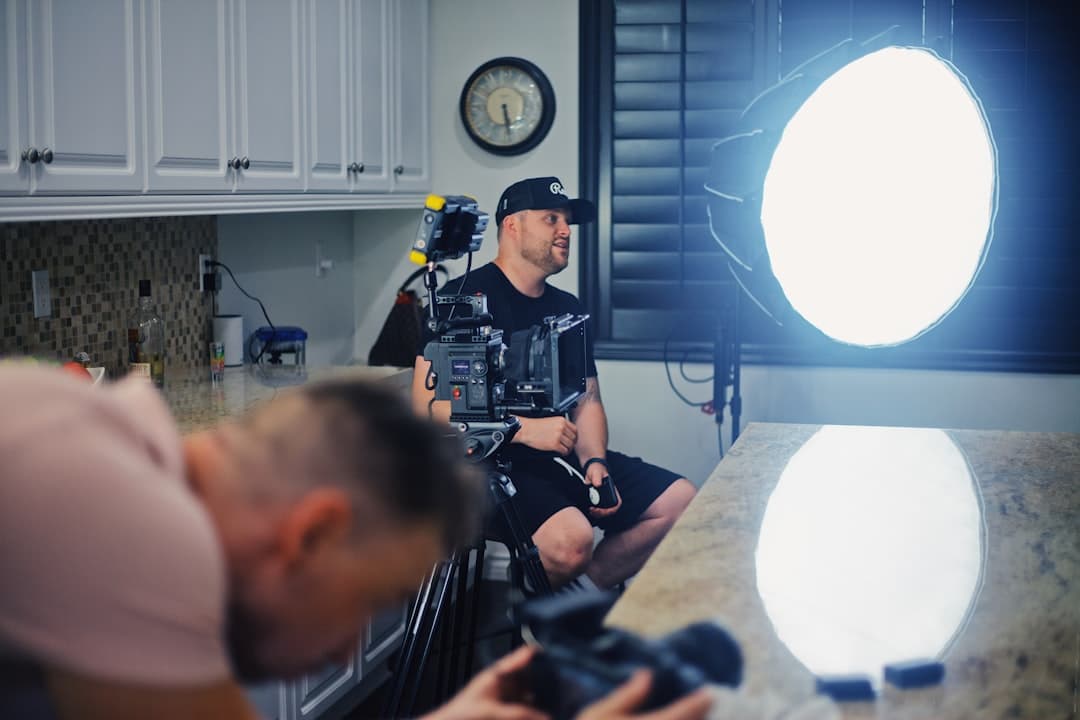
Photo by Gordon Cowie on Unsplash
Two departments, one image
Most newcomers don't realize that the lighting team and the grip team are two separate departments. Roughly:
- Electric department (the gaffer, best boy electric, and electricians): brings the lights, the power, and turns the fixtures on.
- Grip department (the key grip, best boy grip, and grips): shapes, redirects, blocks, and modifies the light those fixtures put out.
A fixture without a grip is just a fixture. The light spills everywhere, hits everything, makes no choices. The grip is the one who puts a flag on a c-stand and chooses where the light goes.
On small productions, the same person does both — and you should understand the distinction even if you're a one-person crew, because the two thinking modes are different.
The geometry of light
Light from a fixture leaves the bulb and travels in a cone outward. As it travels, it:
- Diverges (spreads out)
- Falls off in intensity (inverse-square law — distance kills brightness fast)
- Hits surfaces which reflect, absorb, or transmit it
A grip works at every point in that journey:
- At the source — they can put a softbox, diffusion, or scrim on the fixture to change its character before it leaves.
- In flight — they can put a flag, net, or solid in the light's path to block or reduce it.
- At the subject — they can put a flag on the shadow side for negative fill, or a bounce on the fill side to redirect light back.
- Behind the subject — they can shape the background lighting independently.
Every grip tool is a way to control one of those four moments.
The toolkit
Flag. A black opaque rectangle (cloth on a wire frame). Blocks light. Sizes: 18×24, 24×36, 4×4, larger for "solids."
A flag's job: stop light from hitting somewhere you don't want it. Common uses:
- Keep your key light off the background (the actor is lit, the wall isn't)
- "Cutter" — a flag positioned to keep light off one side of the actor's face (a hard line on the cheekbone)
- "Topper" — flag above the actor to keep light off their hat or forehead
- "Sider" — flag on the side to block spill
A skilled grip can shape a face like a sculptor with three flags and one fixture.
Net. Like a flag, but made of black mesh that reduces light without blocking it. Density classes:
- Single net — about 1/3 stop reduction
- Double net — about 2/3 stop reduction
- Lavender — silk-like, very subtle reduction with slight diffusion
- Open-end nets — net with one short side open (so you can slip it past objects)
Nets are how a grip "fixes a hot spot" — that bright patch on the wall behind the actor's shoulder. A single net pulled into the light path knocks it down a stop without darkening anything else.
Silk. White translucent fabric on a frame. Diffuses hard light into soft light. Sizes:
- 4×4 silk — the workhorse for a single subject
- 6×6 silk — for a wider area or further-source diffusion
- 8×8, 12×12, 20×20 — for full-scene daylight diffusion, usually rigged with a "butterfly frame" or "overhead"
- Light grid cloth, full grid, half grid — increasing density of diffusion (more diffusion = softer light but more loss)
Butterfly. A large frame (usually 6×6, 8×8, or 12×12) that holds diffusion or solid material. Used outdoors to either soften the sun (silk fill) or block it entirely (solid). A "20×20 butterfly" is the giant overhead silk on outdoor shoots, often rigged on tall combo stands.
Solid (or "floppy solid"). A non-translucent black panel that blocks light completely. A 4×4 solid is a portable shade-maker — useful for putting an actor in instant deep shade right next to direct sun.
Bounce card. White (or beadboard, silver leaf, gold leaf) panel that reflects light back. The other-side-of-the-flag — instead of blocking, it redirects. Standard sizes match grip flags.
Cookie (Cucoloris). A wood or plastic panel with random patterns cut out. Placed in front of a light, casts dappled shadow patterns — often used to add "broken-up" light texture to a flat wall (mimicking leaves overhead or window blinds).
Snoot. A tube placed on the front of a fixture to focus its beam into a tight pool. Hard light, controlled spread.
Grid (egg crate, eggcrate). A honeycomb-like grid attached to a soft source that controls how widely the soft light spreads — without making it hard. Useful when you want soft light but don't want it lighting the whole room.
Black wrap (Cinefoil). Heavy-duty matte black foil. Wraps around a fixture to control spill from any direction. The grip's quick-and-dirty alternative to a flag — bend it where you need it, hold the light's spill in.
Apple boxes. Discussed in the tools-on-set lesson — used heavily by grips to raise/lower c-stands, support flags, level uneven ground.
Sandbags. Weight down c-stand legs. Critical for safety — a tipping c-stand has injured many a PA.
Stands. C-stand, low-boy combo (low to ground), high-roller (tall), Mombo combo (super-tall and beefy). Match the stand to the load and the height.
The geometry: where to put it
A grip's craft is positioning. Same flag, different position, completely different result.
Distance from source. A flag close to the fixture casts a hard-edged shadow. The same flag further from the fixture (closer to the subject) casts a softer-edged shadow. The geometry: shadows soften as the flag moves away from the source and toward the subject.
Angle of incidence = angle of reflection. When light bounces off a surface, the angle it hits the surface equals the angle it leaves. This determines where a bounce card needs to be to throw light onto a face — and where a window's bounce off a polished floor will end up.
Negative fill on the shadow side. A black flag a foot from the actor's shadow-side cheek deepens the shadow noticeably. The same flag three feet away has much less effect. The flag essentially "soaks up" ambient light that would have filled that shadow.
Cutters across the top of frame. A flag suspended overhead just outside frame is the "topper." Keeps the key light from spilling onto the wall behind, or off the actor's hat brim.
The "set" angle of cuts. Standard pro shorthand: a "hard cut" means the flag's shadow line lands exactly on the actor's jawline (or where the shadow needs to fall). A "soft cut" is the same idea but pulled further away so the shadow edge softens.
Reading a lit frame as a grip
When you look at a well-lit shot, you can often "see" the grip work:
- The bright fall-off behind the actor's head? Probably a flag on the background light.
- The way the actor's hand is in shadow while the face is lit? Maybe a flag-cutter on the key light to keep the hand dim.
- The patch of window light on the floor matching reality even though the camera angle changes? A bounce on the floor between window and camera.
Once you can spot the cuts, you start thinking like a grip. Most DPs who win awards have a key grip who's been with them for years.
Common mistakes
- Light spill everywhere. No flags, no shaping. Result: even, flat, lit-from-everywhere look. Add cuts.
- Background brighter than subject. Your wall is hotter than your face. Flag the key off the wall, or net the background.
- Forgetting safety. C-stands tip. Always sandbag, especially with anything overhead.
- Cookies overused. A "cookie pattern" on every wall looks fake. Use sparingly.
- Solid where a net was meant. Solid blocks completely; net reduces. Don't confuse them.
- One stand, multiple loads. A c-stand holding both a flag and a fixture is fragile. Use separate stands.
What to practice this week
Set up one light on a stand pointed at a face. Then, with nothing but a c-stand and a 24×36 flag, modify the shot in three ways:
- Topper — flag above the actor blocking the top of the spill
- Sider — flag to the side, cutting off the spill onto the wall behind
- Negative fill — flag opposite the key, deepening the shadow side of the face
Don't change the fixture position. Just move the flag. Watch how the shape of the face changes with each new cut.
That's grip work. The same exercise with a bounce card on the fill side (instead of negative fill) shows you the symmetric trick.
After 20 minutes of this, you'll understand why DPs guard their key grips. The flags are doing as much storytelling as the fixtures.
More lessons
Browse all
Audio
Audio fundamentals for video
Why bad audio kills good footage — and how to capture clean sound on a small crew
Audio
Multi-track audio workflow for narrative
Capturing lavs, boom, ambience, and timecode reference cleanly on a multi-input recorder
Business & freelance
Showcasing your work online
A reel that gets calls back, a portfolio site that works, and the basics of being findable
Found this useful?
Bookmark BOLD University and share it with someone learning the craft. New lessons go up regularly.
Back to University