Camera & rigging
Camera movement: when each tool fits
Tripod, dolly, slider, jib, Steadicam, gimbal — what each does and the storytelling reason to choose one
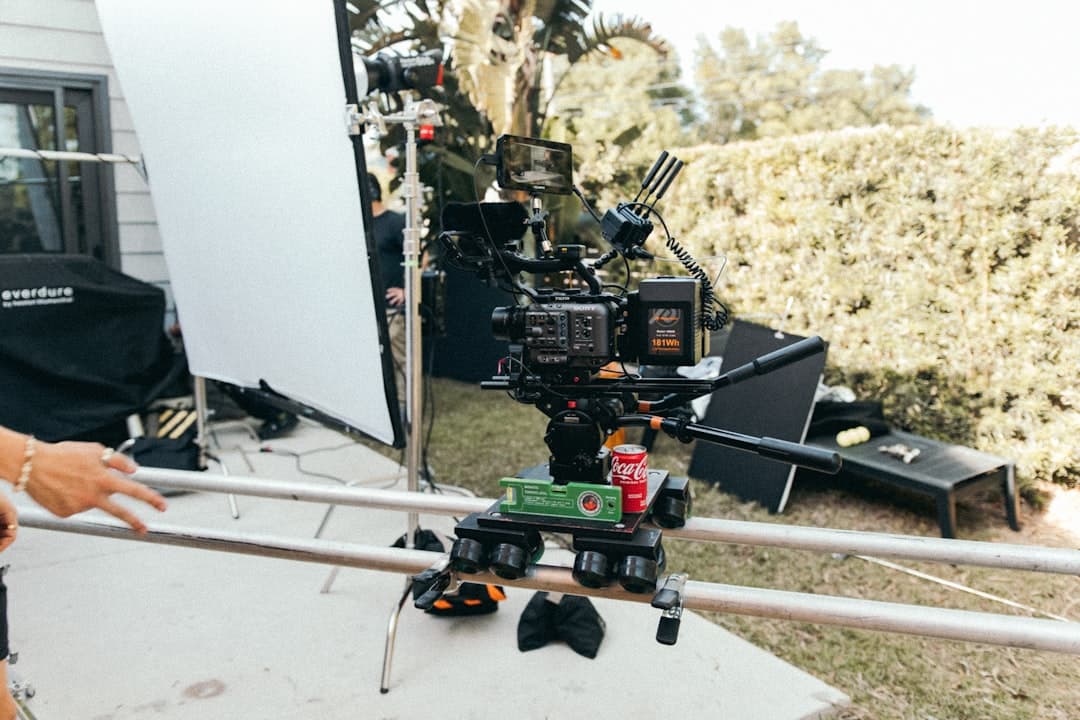
Photo by Kyle Loftus on Unsplash
Movement is meaning
Every time you move the camera, you tell the audience something. Camera movement isn't decoration — it's grammar.
- A locked tripod says: stillness, observation, restraint.
- A dolly says: gradual approach, building intimacy.
- A slider says: a small reveal, a subtle change of perspective.
- A jib says: scale, height, "look at how big this is."
- A Steadicam says: walking with the character, fluid and human.
- A gimbal says: smooth motion, freedom from physical constraints.
Picking the right tool for a shot is half the work of telling the story. This lesson covers the six common tools and the storytelling reason to choose each.
Tripod
Stillness. The most underrated movement choice is no movement.
When the camera doesn't move, the audience focuses on what's happening within the frame. A locked-off shot lets the actors do the work. It's the default for:
- Interview format
- Wide establishing shots that need to feel grounded
- Comedy (movement steals the joke)
- Anywhere you want the audience to feel like they're observing
Tripods come in tiers:
- Photo tripods — light, cheap, but not built for fluid pan/tilt. Avoid for video.
- Video tripods with fluid heads — Manfrotto 504X, Sachtler Aktiv6, OConnor 1030. The fluid head is the difference — it gives smooth, controlled pans without judder.
- Studio pedestals — for broadcast / multi-cam interview setups where the camera moves but stays smooth.
The fluid head matters more than the legs. Invest in the head.
Dolly
A wheeled platform the camera rides on. Pushes in or pulls out (or sideways "crab" if the dolly has crab wheels).
Storytelling use: gradual building of intimacy or distance.
- Push-in: building emotional weight on a character. The audience leans in with the camera.
- Pull-out: revealing context, often deflating a moment, or showing isolation.
Dolly types:
- Doorway dolly — a large floor-running platform pushed by a grip. Indie standard.
- Skateboard dolly — small, runs on a track. Slider's bigger cousin.
- Slider — a small, portable rail system, 2–4 feet long. Most indie shooters call this their "dolly."
- Doorway / track dolly — full-size, used on bigger productions, runs on dolly track.
For most narrative or commercial work, a slider or doorway dolly is enough. Dolly track is for productions with the budget for grip days.
Slider
A short rail (typically 2–4 feet) with the camera on a slider plate that glides side-to-side or in-out. Operated by hand or motorized.
Storytelling use: small reveal moves. A slider gives you 2–4 feet of motion — enough to feel like the camera moved, not enough to traverse a scene. Common applications:
- Parallax reveals (object in foreground passes; subject in background revealed)
- Subtle reframe during dialogue (small dolly-in on a key line)
- Slow reveal of a logo or product (for commercial work)
- Time-lapse moves (motorized sliders shine here)
Motorized sliders (Edelkrone, Rhino, Syrp Genie) let you program slow, controlled moves — often slower than a human can hold steady. Worth it for product work.
Jib / crane
A counterweighted arm that lifts the camera up and lowers it down. Pivots vertically and horizontally.
Storytelling use: scale. A jib shot says "this is bigger than you can see from one angle." Examples:
- Wide establishing shots that start high and lower to ground level
- Reveals of large spaces (a venue, a stadium, a landscape)
- "Sweeping" moves above a crowd
- The classic ending shot — pulling back and up to show context
Jibs come in sizes from 5-foot indie units up to 30+ foot crane arms with operators. For most independent work, a 5–10 foot indie jib suffices.
Practical caveats:
- Jibs need space (3 feet on either side of the pivot point)
- They take 30+ minutes to set up
- Best for prepared shots, not run-and-gun
- Wind affects them outdoors
Steadicam
A body-mounted mechanical stabilizer. The operator wears a vest and arm; the camera hangs on a balanced gimbal that the operator's body movements don't transfer to.
Storytelling use: walking with the character. Steadicam glides; the audience walks with the action. Iconic Steadicam shots include the Copacabana shot in Goodfellas, the kitchen shot in The Shining, the boxing sequence in Rocky.
Tradeoffs vs. gimbal:
- Pros: long-form sustained moves (5+ minutes), heavier camera packages, more "feel" of human presence
- Cons: requires a trained operator (real training), expensive (rentals $500–$1500/day plus an operator), and the operator can't run as fast as a gimbal can
For most filmmakers, a gimbal does 80% of what a Steadicam does at 10% of the cost. Steadicam shines on narrative work where the camera "needs to feel human" or the run-time exceeds gimbal battery life.
Gimbal
A motorized 3-axis stabilizer (Ronin, Movi, Möhre, DJI RS series). Battery-powered. Camera mounts on a balanced arm; brushless motors counteract operator movement.
Storytelling use: smooth motion, often in dynamic situations.
- Running, walking, vehicle-mounted moves
- Tight indoor work where dolly track wouldn't fit
- Fast direction changes
- Low-angle moves inches from the ground
Modern gimbals have revolutionized indie filmmaking. Tradeoffs:
- Setup time: 15–20 minutes to balance for a new lens or camera config
- Battery life: 8–12 hours typical
- Weight: bigger gimbals (RS3 Pro+) can fatigue an operator in 30 minutes
- Focus pulling: gimbals make manual focus difficult; rely on AF or wireless focus motors
A common gimbal mistake: using it for everything because the moves look smooth. Result: footage that all has the same characterless flow. Mix it with tripod and handheld for variety.
Picking the right tool for a shot
A few practical questions to ask before each move:
1. What does this shot need to say? If "stillness, observation" — tripod. If "approach, intimacy" — dolly. If "smooth journey alongside the character" — Steadicam or gimbal.
2. What's the practical environment? Tight indoor with no room for grip equipment — gimbal or handheld. Wide outdoor with all the time in the world — jib or dolly track.
3. How long is the shot? Anything over a minute that needs perfect stability — Steadicam (gimbal batteries die). Short bursts of motion — gimbal.
4. How fast does the camera need to move? Sprinting after action — gimbal. Slow building approach — dolly. Sweeping over a crowd — jib.
Common mistakes
- Movement for movement's sake. Don't move the camera just because you can. Each move should justify itself.
- One tool for everything. A whole project shot only on a gimbal feels homogenous and "produced" in a bad way.
- Forgetting the tripod. New filmmakers especially over-rely on motion. Locked-off shots are often the strongest in a piece.
- Mis-budgeting setup time. A dolly or jib shot can eat 30–60 minutes of crew time per setup. Plan around it.
- No counterweight planning. A front-heavy gimbal or jib will eat your day.
What to practice this week
Pick a 30-second piece of yours. List every camera move. Then, for each move, ask: "what would happen if this was a locked-off shot instead?"
Most of the time, the locked-off version is stronger.
Then take that same piece and try shooting it a second time with only one type of movement (all tripod, or all gimbal, or all slider). You'll feel the limitation, but you'll also see how the constraint forces stronger compositions.
The best filmmakers don't have more tools — they pick the right tool more carefully.
More lessons
Browse all
Camera & rigging
Understanding depth of field
How to get the cinematic look — intentionally, not by accident
Camera & rigging
Building a camera rig that doesn’t fight you
Handheld, shoulder, and gimbal — what to build for what shoot
Audio
Audio fundamentals for video
Why bad audio kills good footage — and how to capture clean sound on a small crew
Found this useful?
Bookmark BOLD University and share it with someone learning the craft. New lessons go up regularly.
Back to University